Heat is the primary catalyst in coffee brewing, rapidly dissolving soluble flavor compounds within minutes. Remove heat from the equation, and the solvent—water—must rely entirely on prolonged contact time to achieve proper extraction. Cold brew architecture is designed to manage this extended temporal variable. The resulting beverage is chemically distinct from its hot-brewed counterparts: lacking the volatile aromatics that require heat to vaporize, but presenting a profoundly smooth, low-acidity profile that appeals to a massive segment of consumers.
Full Immersion Systems
The most common and accessible form of cold water extraction is full immersion. In this method, coarsely ground coffee is fully submerged in a vessel of ambient or refrigerated water and left to steep for 12 to 24 hours.
The hardware involved is relatively simple, but effective filtration is paramount. Premium immersion brewers utilize heavy-duty borosilicate glass carafes paired with micro-mesh stainless steel filter cores. The primary challenge of immersion brewing is sediment. Because the grounds sit in the water for up to a day, the coffee particles break down. If the filter mesh is not fine enough, microscopic silt passes into the concentrate, leading to a gritty mouthfeel and continued, harsh extraction in the fridge. For this reason, some professional setups employ two-stage filtration: draining the coarse mesh basket, and then pouring the resulting concentrate through a dense paper filter to achieve maximum clarity.
Immersion systems typically produce a dense concentrate. Because the coffee bed sits in heavily saturated water, extraction slows as the water approaches equilibrium. The resulting liquid is highly caffeinated and rich in chocolate and nutty notes, intended to be diluted with water or milk before consumption.
Slow-Drip (Kyoto-Style) Towers
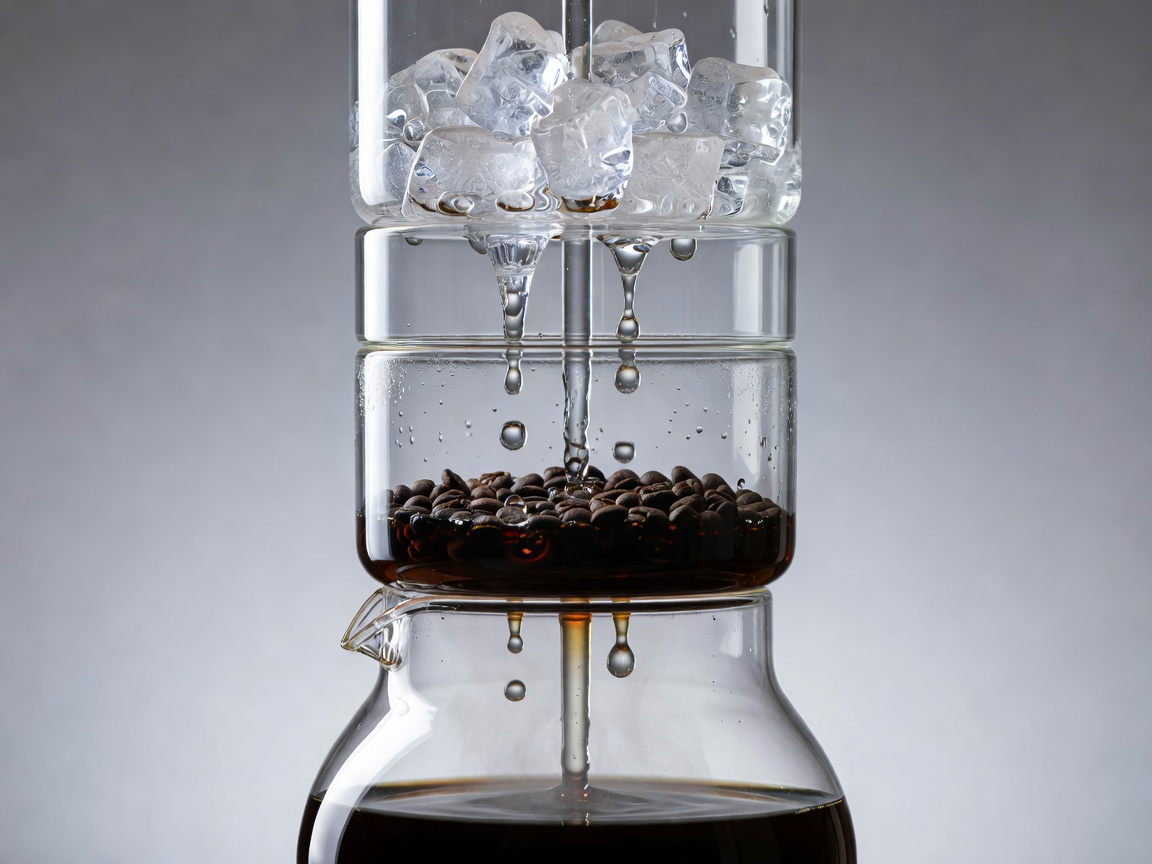
A more visually striking and mechanically complex approach to cold extraction is the slow-drip tower. Originating from historic Dutch trading ships and refined in Kyoto, Japan, these towering structures of glass and brass utilize gravity and extreme precision to brew coffee drop by drop.
The architecture consists of three chambers:
- The Upper Reservoir: Holds ice water. A precision valve (often a brass petcock) at the base allows the user to calibrate the drip rate—typically one drop every 1 to 2 seconds.
- The Coffee Chamber: A glass cylinder holding a bed of ground coffee, topped with a paper dispersion filter to ensure the falling drops spread evenly across the surface rather than drilling a hole.
- The Lower Carafe: Collects the brewed liquid over a period of 6 to 12 hours.
Unlike immersion, the slow-drip method is a continuous percolation process. Fresh, clean solvent is constantly introduced to the coffee bed, passing through and exiting. This continuous flow extracts a wider array of flavor compounds than static immersion. Kyoto-style cold brew is celebrated for its clarity, often retaining the delicate fruity and floral notes of light roast coffees that are typically lost in the muddy depths of an immersion steep. The output is a ready-to-drink beverage with a lighter body and nuanced complexity.
Oxidative Stability
One structural advantage of cold extraction is oxidative stability. Hot-brewed coffee degrades rapidly as heat accelerates the oxidization of oils. Cold brew, created and stored at low temperatures, remains chemically stable for up to two weeks in a sealed container. This makes cold brew apparatus highly efficient for batch preparation, turning the lengthy extraction time from a flaw into an operational advantage.